Sam Whitby
About

Sam Whitby

Inventor and interdisciplinary scientist adept at building biosensing technologies from first principles through to working products. Proficient in computational physics with doctoral experience simulating quantum, biological and electrochemical systems. First employee at Osler Diagnostics: set up the research laboratory from scratch, helped scale the company to over 100 people, and contributed to a $30M Series A funding round.

An effective communicator with a proven record of innovation including patented biosensing technologies and highly original research concepts. Advises multiple biosensing companies through private consultancy, rapidly deploying advanced computational models to address bespoke R&D requirements.
Experience & Education

Curriculum Vitae

Experience

2020–2025

Private Consultant · Biotechnology Startups

Provided consulting to multiple clients on proprietary biosensing methods — delivering literature reviews, scientific advice on electrochemical devices, and bespoke software, simulations and models. Clients include Osler Diagnostics, Sense-Bio (now OraSure Technologies), and the Compton Group, Oxford.

2019–2020

Senior Scientist · Osler Diagnostics

Project lead for Blood Chemistry R&D. Managed 5–10 scientists to develop quantitative electrochemical assays for proteins, ions and metabolites. Translated assays to a second-stage prototype, collaborating across electronics, microfluidics, and embedded software teams. Invented a novel method for high-throughput electronic multiplexing.

2017–2019

Scientist · Osler Diagnostics

First hired employee. Established the research laboratory and translated biosensing technology from the University of Oxford into the company. Delivered a functioning prototype point-of-care device capable of measuring multiple protein biomarkers in blood, contributing to a $30 million Series A raiser.

Education

2021–2026

PhD in Bioengineering · Imperial College London

Thesis: "Memory in Models of Molecular Assembly". Supervised by Dr Chiu Fan Lee and Dr Thomas Ouldridge. Funded by the President's Scholarship. Passed examination February 2026, examined by Prof Jon Doye and Dr Ruben Perez-Carrasco. Work presented at Physics of Emergent Behaviour IV (Harrogate, 2023), Imperial Early Career Research Symposium (2023), and Smart Condensates and Droplets Symposium (Cambridge, 2024).

2013–2017

MChem Chemistry · University of Oxford

First Class Honours (average 80%), first prize for best thesis. First on all 16 examination papers. Master's thesis: "Application of the Frozen Gaussian Approximation with Stochastic Surface Hopping to Non-adiabatic Photochemistry".

Technical Skills

Python Mathematica Fortran JAX Monte Carlo methods Machine learning Finite-element methods Electrochemistry Immunoassay development Biosensor design Potentiostat design Qualified phlebotomist
Research

Publications & Patents

Publications

2026

Memory in Models of Molecular Assembly

Whitby, S.

PhD Thesis — Imperial College London

View thesis ↗
2017

Application of the Frozen Gaussian Approximation with Stochastic Surface-Hopping to Nonadiabatic Photochemistry

Whitby, S.

Master's Thesis — University of Oxford

View thesis ↗
2016

Single Nanoparticle Voltammetry: Contact Modulation of the Mediated Current

Li, X., Batchelor-McAuley, C., Whitby, S. A. I., Tschulik, K., Shao, L., & Compton, R. G.

Angewandte Chemie International Edition, 55(13), 4296–4299

doi:10.1002/anie.201509017 ↗

Patents

2023

Device for detecting presence or absence of a chemical or biological target within a sample

Whitby, S.

U.S. Patent Application US 2023/0020979 A1 — Electrode functionalised with an antibody and corresponding detection method

US 2023/0020979 A1 ↗
2024

Methods for immunoassays using electrochemical measurement

Sokolov, S., Merotra, J., Psarros, K., Whitby, S., Dos Santos, A., & Bedatty Fernandes, F. C.

U.S. Patent 12,168,794

US 12,168,794 ↗
Open Source

Selected Projects

A selection of public work spanning computational science and engineering. Consultancy work is held in private repositories.

Detailed Balance Checker
Code Checking for Computational Physics

Detailed Balance Checker

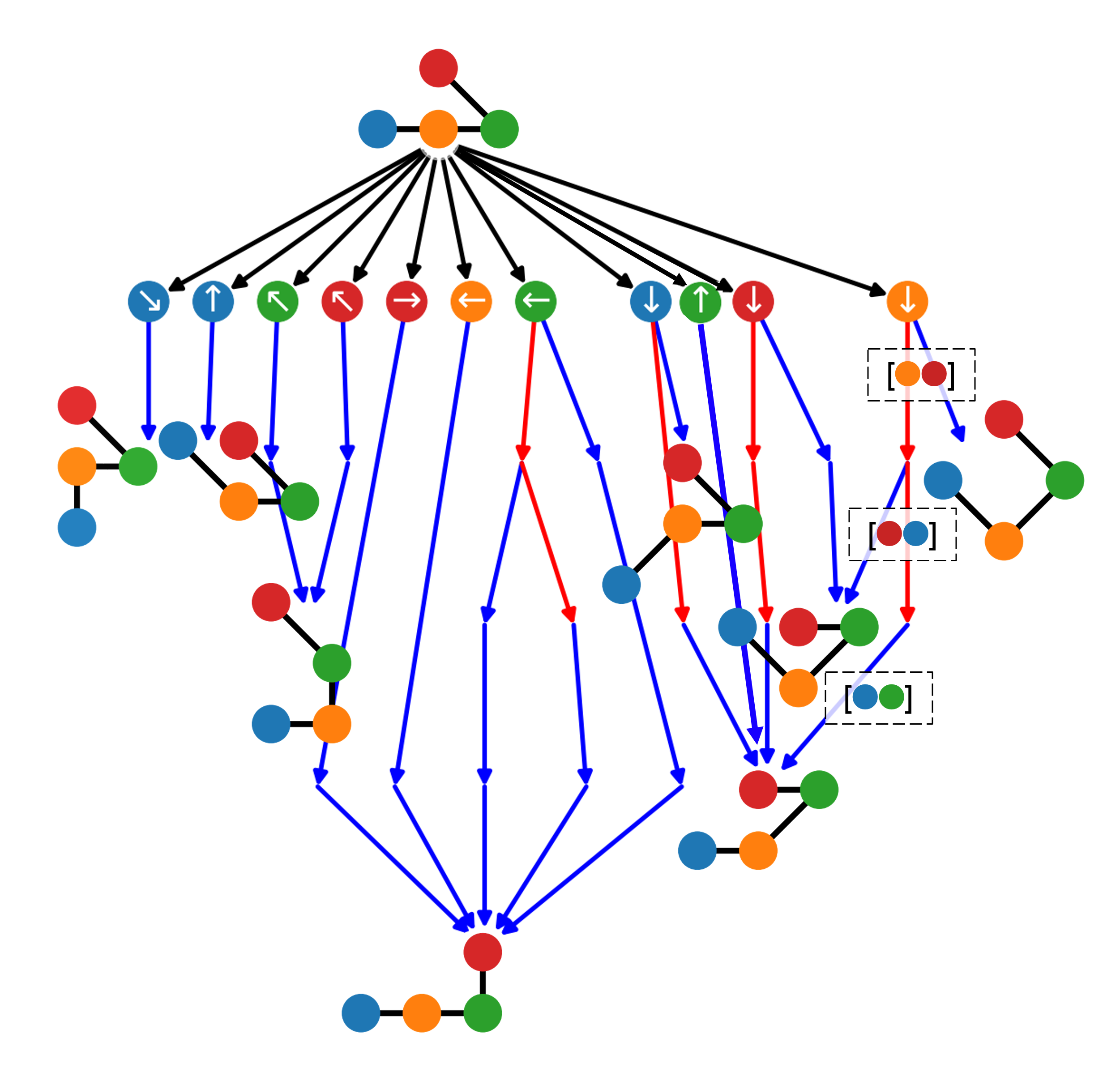
Takes an MCMC algorithm file and exhaustively enumerates all reachable states by breadth-first search, constructing the exact symbolic transition matrix. For every state pair it verifies the detailed balance condition using Mathematica's FullSimplify with energy parameters treated as real symbols, yielding a deterministic PASS or FAIL. Used to certify novel Monte Carlo algorithms developed during PhD research into protein self-assembly, catching detailed-balance violations that would silently produce wrong equilibrium statistics.

Wolfram Language
CRN Autodiff
Single Molecule Computation through Machine Learning

CRN Autodiff

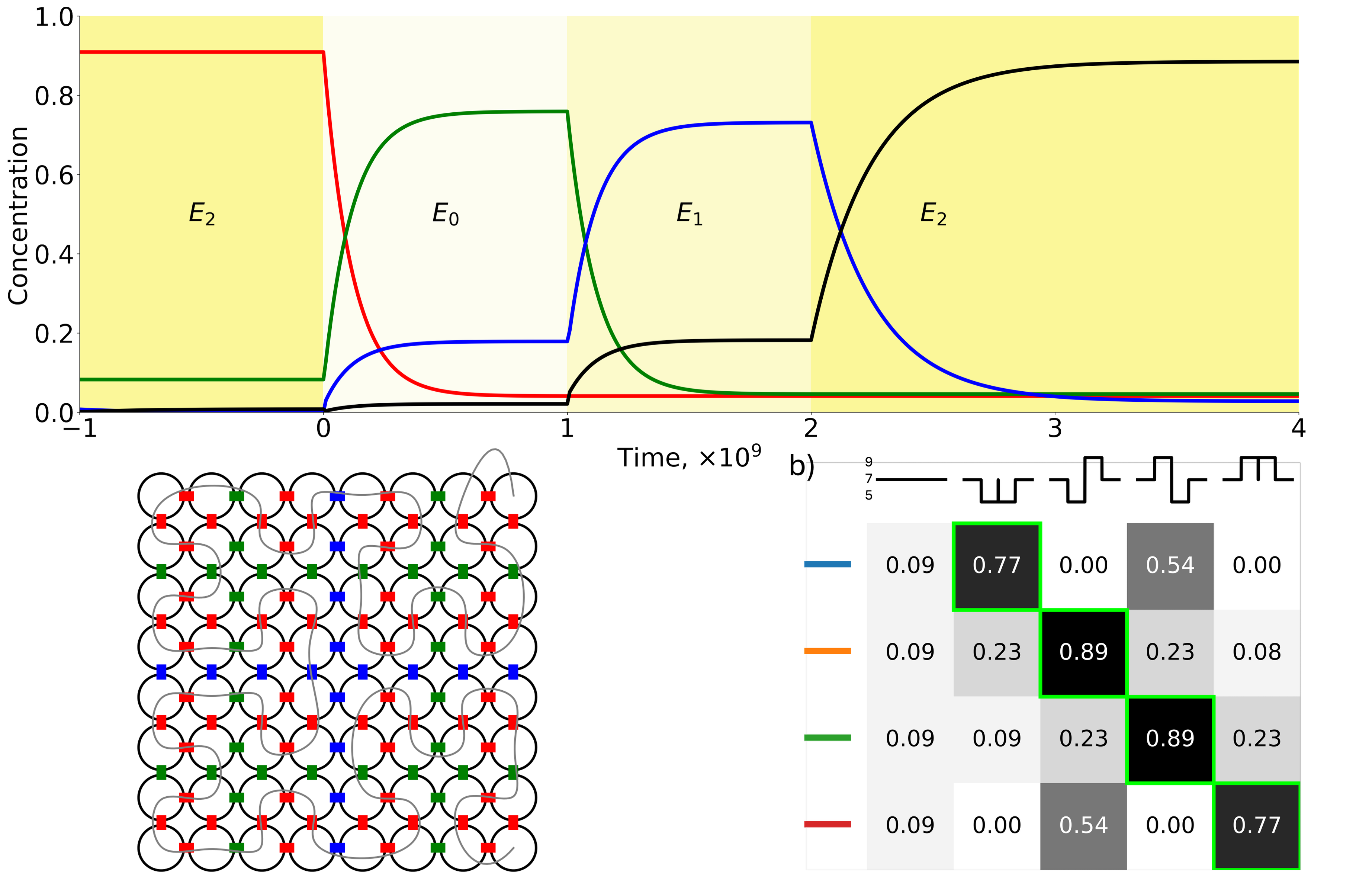
Models a single molecule consisting of charged acid/base monomers whose dimerisation rates shift with pH via the Henderson–Hasselbalch equation. Relevant parameters are trained end-to-end using JAX automatic differentiation through a Diffrax ODE solver, minimising loss so that a specific sequence of pH steps selectively drives correct dimer formation. The trained system encodes a temporal "password" in its thermodynamic parameters: a form of kinetically-controlled single-molecule computation central to PhD research on molecular information storage.

Python · JAX
Simulated Circuits
AI Enabled Electronics

Simulated Circuits

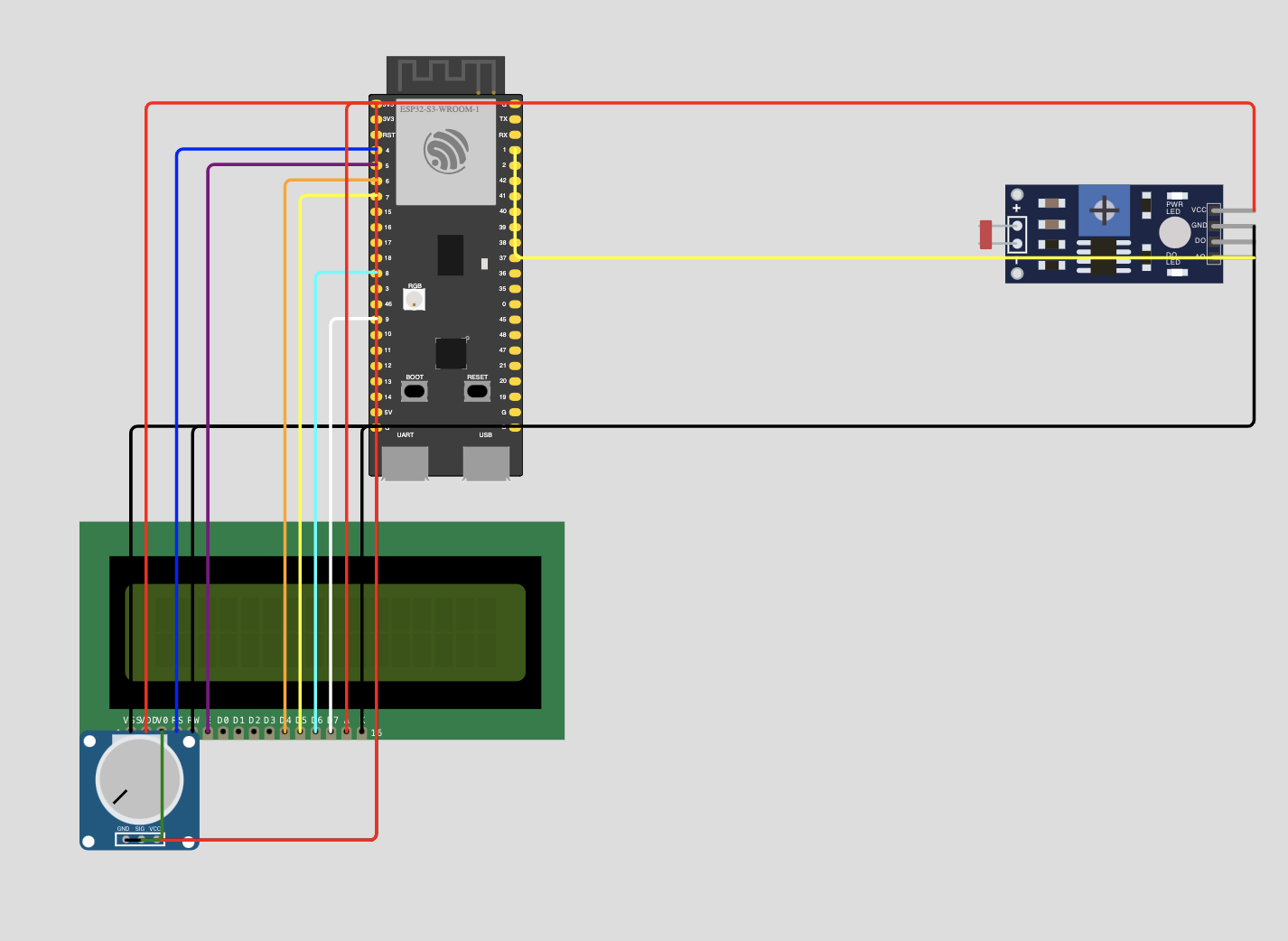
Workflow that allows Claude Code to design, wire, simulate, and verify embedded hardware circuits autonomously, closing the iterative design loop for automated AI development. Provides libraries of exact board pin files, writes the circuit diagram and firmware, compiles it, lints it, runs it in a headless Wokwi simulator, asserts against serial output and designs component placement on breadboard — iterating on failures on its own until the circuit passes and then providing detailed assembly instructions like a LEGO kit.

Python, C++, Claude Code
Contact

Get in touch

Available for consulting engagements, research collaborations, and conversations about biosensing, computational science, or creative technology.

samuelwhitby94@gmail.com